NASA's Roman Space Telescope Is Complete and Preparing for a Fall 2026 Launch
NASA's Nancy Grace Roman Space Telescope is fully assembled and undergoing final testing before a Falcon Heavy launch to study dark energy and exoplanets.
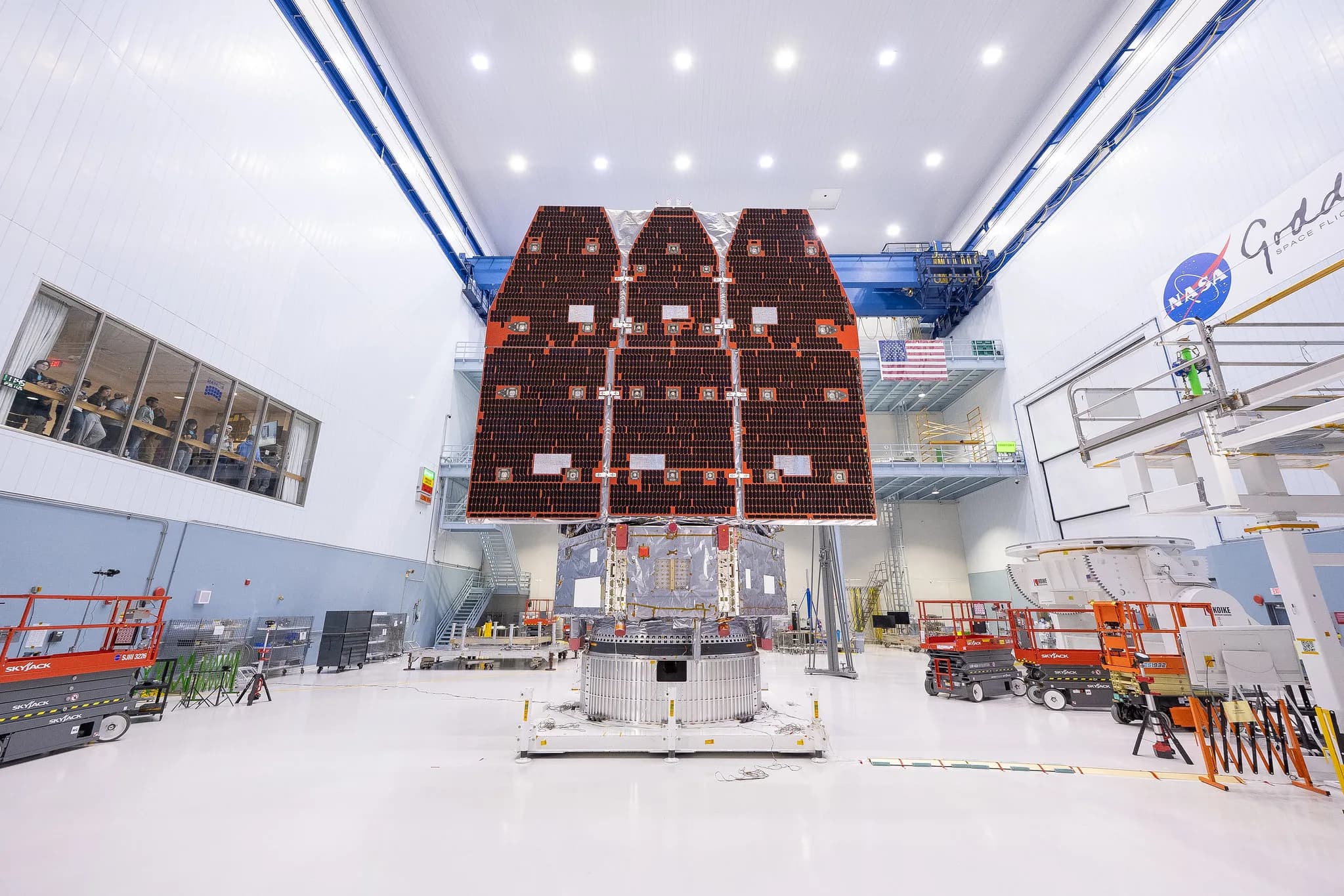
Image: NASA
NASA's next great observatory is built and nearly ready to fly. The Nancy Grace Roman Space Telescope completed assembly on November 25 at NASA's Goddard Space Flight Center in Greenbelt, Maryland, and is now undergoing final environmental testing before shipping to Kennedy Space Center this summer. A SpaceX Falcon Heavy rocket will carry it to a point one million miles from Earth, where it will begin a five-year mission to reshape our understanding of the universe.
2.4m
Mirror Diameter
Matches Hubble
100x
Wider Field of View
vs Hubble
100K+
New Worlds Expected
In first 5 years
5 yr
Primary Mission
A Telescope Built for Scale
Roman carries a primary mirror 7.9 feet (2.4 meters) in diameter - the same size as the Hubble Space Telescope's mirror - but its similarities to Hubble end there. The telescope's Wide Field Instrument has a field of view at least 100 times larger than Hubble's, allowing it to survey the sky 1,000 times faster while maintaining similar sensitivity and infrared resolution.
Two instruments power the mission:
- Wide Field Instrument - designed for massive sky surveys, capturing stars, galaxies, and exoplanets across vast stretches of space
- Coronagraph Instrument - a technology demonstration that will directly image exoplanets, the first space telescope instrument to use numerically optimized coronagraph masks and large-format deformable mirrors
In its first five years, Roman is expected to reveal more than 100,000 distant worlds, hundreds of millions of stars, and billions of galaxies.
Hunting Exoplanets and Dark Energy
Roman will tackle two of astronomy's biggest questions: how common are planets like Earth, and what is driving the universe's accelerating expansion.
Exoplanet Discovery
The Wide Field Instrument will conduct a microlensing survey of the inner Milky Way, monitoring 100 million stars for hundreds of days. Scientists expect the survey to discover approximately 2,500 planets, including rocky planets in and beyond the zone where liquid water may exist. The method is sensitive enough to detect planets smaller than Mars.
Dark Energy Research
Roman will use three independent techniques to probe dark energy - baryon acoustic oscillations, observations of distant supernovae, and weak gravitational lensing. These wide, deep surveys will discover cosmic mile-markers by the thousands, building a high-precision history of the universe's expansion rate and how it has changed over time.
On Track for Launch
The telescope recently completed environmental testing to confirm it can withstand the vibrations of launch. After final checks, Roman will move to Kennedy Space Center in Florida this summer for launch preparations. The team is targeting a launch as early as fall 2026, with a deadline of no later than May 2027. It will launch from Launch Complex 39A aboard a Falcon Heavy.
Launch Details
Nancy Grace Roman Space Telescope
Vehicle
Falcon Heavy
Orbit
Sun-Earth L2
Launch Site
KSC LC-39A
Date
Fall 2026
NASA has already opened Cycle 1 community science proposals, inviting astronomers to compete for observing time. The move signals that Roman has transitioned from a development project to a working scientific platform preparing for operations.
With the James Webb Space Telescope studying the universe in unprecedented detail and Roman about to survey it at unprecedented scale, the next era of space astronomy is taking shape.