This Week in Space Tech #35
Welcome to This Week in Space Tech. This edition covers April 13 through April 19, 2026.
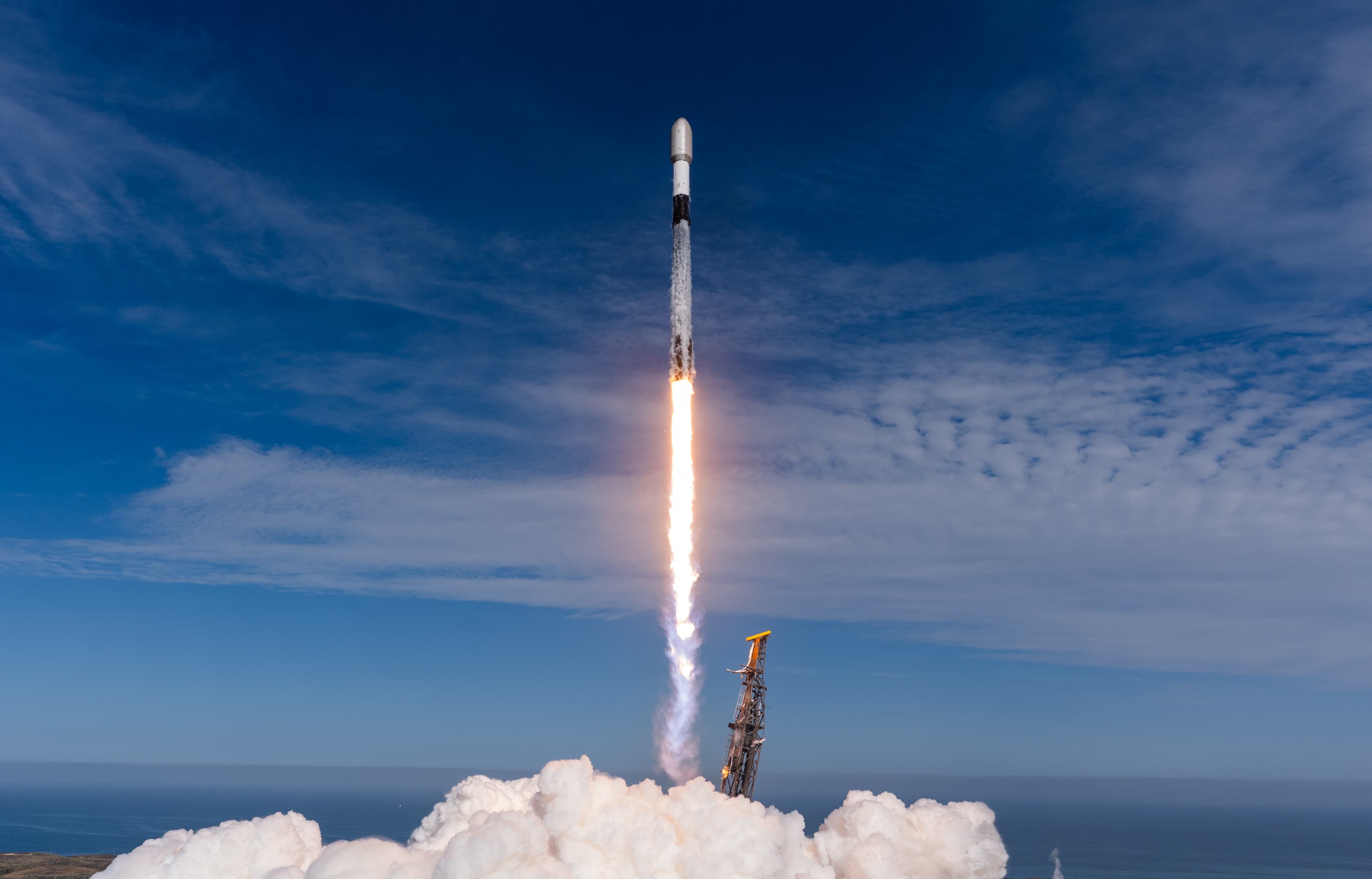
Image: SpaceX
A week defined by two things above all: the biggest gathering of space professionals on the planet, and a rocket that achieved something historic and then failed at the very last step. Starship crossed a major engineering threshold on both stages. And SpaceX hit a number that deserves a moment of genuine reflection.
The 41st Space Symposium Dominates Four Days in Colorado Springs
The Space Foundation's annual gathering, often called the Davos of Space, ran from April 13 through April 16 at The Broadmoor in Colorado Springs, and this year it drew more than 11,000 attendees and 300 exhibitors across military, government, and commercial sectors.
- The unmistakable backdrop of the entire event was Artemis II. The mission had returned its crew just three days before the Symposium opened, and its energy was everywhere: in the exhibit halls, which featured lunar rover prototypes, nuclear propulsion demonstrations, and a full-scale commercial space station mockup; in the keynote halls, where agency leaders from NASA, ESA, and Space Force talked about what comes next; and in the subtext of virtually every panel session focused on building versus discussing a permanent human presence beyond Earth orbit. On April 16, the last day of the Symposium, the four Artemis II astronauts held their first public news conference since returning to Earth, speaking from NASA's Johnson Space Center in Houston.
- One of the most concrete institutional announcements came on April 15, when Maj. Gen. Stephen Purdy, senior space acquisition advisor to the Air Force Secretary, told the audience that the U.S. Space Force would establish a new Cislunar Coordination Office. The office is designed to bring together program managers, engineers, and partner organizations from across government to build acquisition roadmaps for cislunar technology and operations. Chief of Space Operations Gen. Chance Saltzman told reporters the same day that wherever U.S. national interests extend, including to a lunar base, the Space Force would need to be ready to ensure security and sustainability in that environment. The announcement represents the first formal institutional step by the military toward treating the Earth-Moon space as an operational theater.
- On April 16, NASA announced that it had formally authorized the Rosalind Franklin Support and Augmentation project to move into implementation. This is NASA's contribution to ESA's Rosalind Franklin rover mission to Mars, covering the launch vehicle, the lander propulsion system, thermal hardware, and portions of the onboard chemistry instrument. NASA confirmed it has selected SpaceX's Falcon Heavy to carry the rover to Mars, targeting a launch no earlier than late 2028. ESA Director General Josef Aschbacher had spoken about the mission's scientific ambitions at the Symposium on April 14 without addressing the political dimension, as a Congressional fight over NASA's proposed 2027 science budget cuts ran in parallel with the event throughout the week.
SpaceX Fires Both Halves of Starship V3 in Back-to-Back Days
The week of April 13 will be remembered in the Starship program's history as the week the V3 vehicle demonstrated it was ready to fly.
- On Wednesday, April 15, SpaceX ignited all six Raptor 3 engines on Ship 39 at the Massey's Outpost test stand at Starbase, Texas, for a full 60-second burn. It was the first full-duration firing of a V3 Starship upper stage. The test used a new steel truss structure built specifically over the Massey's flame trench to hold the ship during engine testing. Ship 39 carries three sea-level Raptor 3 engines in the inner ring and three vacuum-optimized variants on the outer ring, together generating approximately 1,700 tonnes of combined thrust.
- The following day, April 16, Booster 19 completed a static fire of all 33 Raptor 3 engines at Pad 2, the first-ever 33-engine firing at SpaceX's new second launch complex. The test lasted approximately three seconds, which SpaceX confirmed was intentional. The company posted on X: "First 33-engine static fire for Super Heavy V3." Later that same day, teams conducted a wet dress rehearsal with Booster 19 still on the pad, loading nearly 4,000 metric tonnes of propellant in just 30 minutes, a loading speed SpaceX said is faster than a fully stacked Falcon 9, despite carrying more than 10 times the propellant mass.
- With both static fires complete, both vehicles began their return to the production facility for final closeout checks before full-stack integration ahead of Flight 12. Elon Musk had stated on April 3 that the first V3 Starship flight was four to six weeks away. The successful completion of both engine campaigns kept that timeline intact, pointing toward a mid-May launch attempt from Pad 2. No catch attempts are planned for Flight 12; Booster 19 will splash down in the Gulf of Mexico and Ship 39 in the Indian Ocean, mirroring the profile used on Flights 10 and 11 while pushing the V3 hardware through its first full-duration ascent.
Blue Origin Reflew New Glenn for the First Time, Then Lost Its Payload
Sunday morning, April 19, was an important day for Blue Origin, and then a painful one.
- New Glenn lifted off from Launch Complex 36 at Cape Canaveral at 7.25 a.m. EDT, carrying AST SpaceMobile's BlueBird 7 satellite, a 6,100-kilogram Block 2 direct-to-smartphone broadband spacecraft. After a 40-minute unexplained hold in the countdown, the seven-engine first stage performed flawlessly, separating cleanly three minutes and nine seconds after liftoff. This was the first time a previously flown New Glenn first stage had ever relaunched. The booster, named "Never Tell Me The Odds," had flown and landed successfully on New Glenn's second mission in November 2025.
- The first stage landing also succeeded, with the booster returning to the drone ship in the Atlantic Ocean and touching down cleanly, demonstrating that Blue Origin's recovery infrastructure is ready to support rapid booster reuse. The achievement was significant: consistent booster reuse is a core prerequisite for Blue Origin to compete for the launch frequency and cost structure that its customer manifest demands.
- The upper stage did not keep pace. AST SpaceMobile confirmed Sunday afternoon that BlueBird 7 had been placed into an orbit lower than planned. Blue Origin CEO Dave Limp attributed the fault to one of the upper stage's engines failing to produce sufficient thrust. The satellite separated from the rocket and powered on successfully, but its altitude was too low for its onboard propulsion to correct, making operations impossible. BlueBird 7 will be de-orbited and burn up over the ocean. AST SpaceMobile said the satellite's cost is expected to be covered under its insurance policy, and that successive Block 2 BlueBirds will be ready for launch within approximately a month. The company had committed to having 45 satellites operational in orbit by end of 2026, and this loss is a setback to that timeline, though not a fatal one.
SpaceX Hits 600 Falcon Booster Landings
The milestones in this industry arrive so frequently now that some genuinely significant ones slip by without enough attention. Friday, April 18 deserves a moment.
- During the Starlink 17-22 mission, a Falcon 9 lifted off from Vandenberg Space Force Base at 9.03 a.m. local time carrying 25 Starlink satellites. When the first stage booster returned to land on the drone ship stationed in the Pacific, it marked the 600th successful recovery of a Falcon orbital-class booster in program history.
- The first recovery happened in December 2015. In just over a decade, SpaceX landed 600 boosters. For the first several years, each landing was treated as a significant news event. By 2026, they are so routine that the milestone was the story, not the landing itself. The fleet now includes individual boosters that have flown more than 30 times, and the company is working toward a 40-flight certification target per booster.
- The 600th landing came the same week that two other Falcon 9 missions had also launched: Starlink 10-24 from Cape Canaveral on April 14, and Starlink 17-27 from Vandenberg on April 15. Three Falcon 9 orbital missions in five days is not an anomaly in 2026. It is the operating baseline.