Rocket Lab Completes ESCAPADE Spacecraft Commissioning Ahead of 2027 Mars Arrival
Rocket Lab's twin ESCAPADE spacecraft Blue and Gold have completed commissioning at L2, with Mars arrival set for September 2027 to study atmospheric escape.
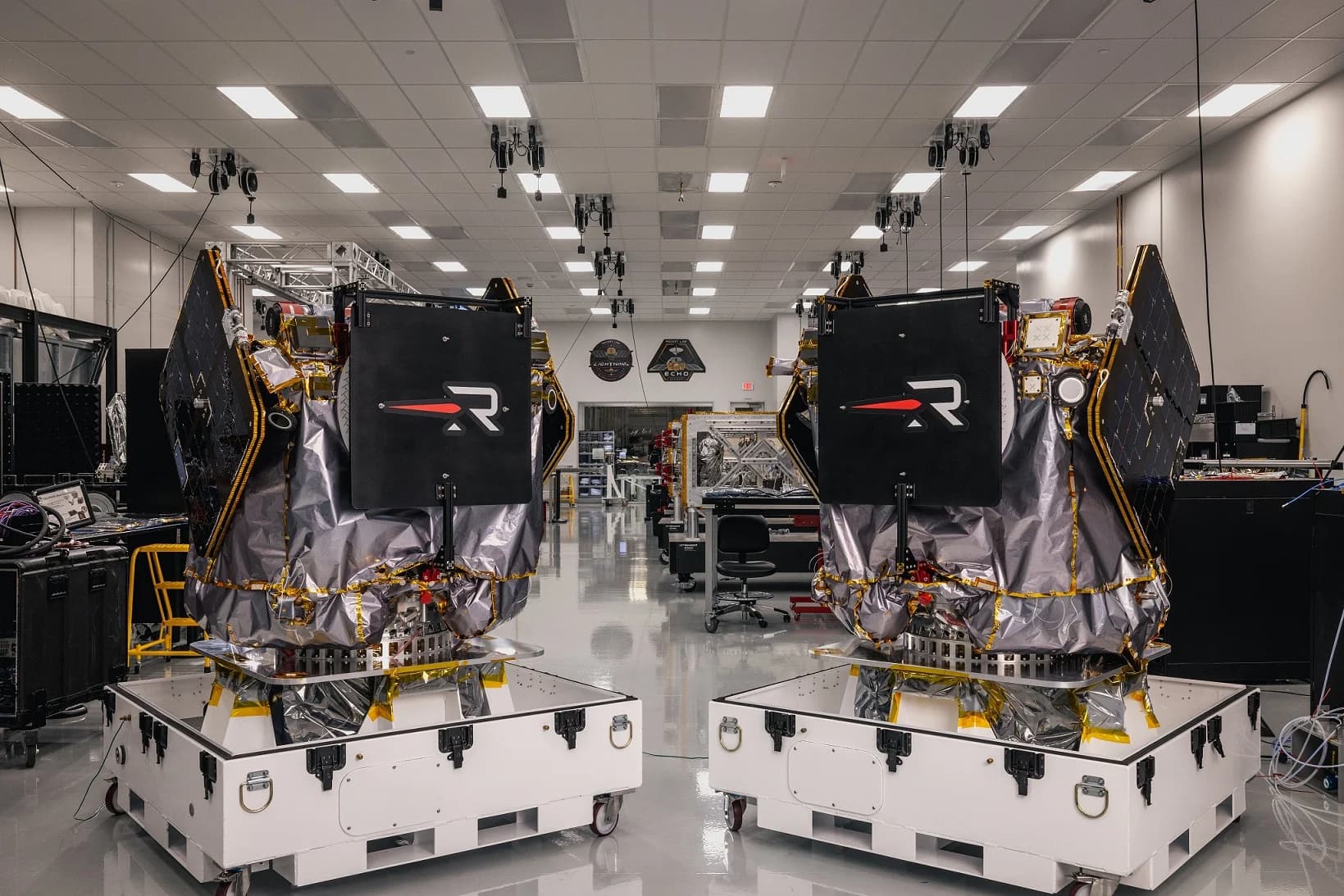
Image: Rocket Lab
Rocket Lab has announced the successful completion of spacecraft commissioning for NASA's ESCAPADE mission, marking a critical milestone as the twin spacecraft prepare for their journey to Mars. The two satellites, named Blue and Gold, are now operating in a loiter trajectory near the Earth-Sun Lagrange Point 2, approximately 1.5 million kilometers from Earth.
ESCAPADE (Blue & Gold)
In TransitMars
|Commissioning complete, loitering at L2 until Nov 2026
From Launch to Commissioning
The ESCAPADE (Escape and Plasma Acceleration and Dynamics Explorers) spacecraft launched on November 13, 2025, aboard Blue Origin's New Glenn rocket from Cape Canaveral Space Force Station. The launch marked New Glenn's second mission, which also achieved a successful first-stage booster landing on the seafaring barge Jacklyn.
Following deployment, both spacecraft executed two precise trajectory correction maneuvers to reach their loiter position near L2. Rocket Lab confirmed that all major systems - including solar arrays, reaction wheels, propellant tanks, star trackers, and avionics - are functioning as expected after commissioning wrapped up on February 26, 2026.
"ESCAPADE proves what's possible when government, university and commercial teams come together with ambition, drive, and determination to do things differently." - Sir Peter Beck, Rocket Lab Founder and CEO
The Road to Mars
The twin spacecraft will remain near L2 until November 2026, giving the mission team at the University of California, Berkeley Space Sciences Laboratory (UCB-SSL) time to test science instruments and collect early heliophysics data. When the next Mars transfer window opens in late 2026, Blue and Gold will perform a gravity assist maneuver around Earth to slingshot toward the Red Planet.
ESCAPADE Mission Timeline
Nov 2025
Launch
Twin spacecraft launched on Blue Origin New Glenn from Cape Canaveral
Feb 2026
Commissioning Complete
All systems verified, spacecraft loitering at L2
Nov 2026
Earth Gravity Assist
Departure toward Mars via Earth flyby
Sep 2027
Mars Arrival
Orbit insertion around Mars using Curie propulsion
2028
Science Operations
Primary one-year science mission begins
Each spacecraft is an Explorer-class interplanetary vehicle based on Rocket Lab's Photon bus, with a dry mass of 209 kg and a fully fueled mass of 535 kg. The Curie propulsion system will handle Mars orbit insertion, placing both satellites into elliptical orbits for a one-year primary science mission.
2
Spacecraft
Blue and Gold
209 kg
Dry Mass
Per spacecraft
535 kg
Fueled Mass
With Curie propulsion
1.5M km
Distance from Earth
Loitering at L2
Unlocking Mars' Atmospheric Secrets
ESCAPADE's dual-spacecraft design gives scientists a unique advantage. By taking simultaneous measurements from two different vantage points, the mission will study how solar wind interacts with Mars' hybrid magnetosphere and strips molecules from the planet's atmosphere.
Understanding this atmospheric escape process is essential for piecing together how Mars lost its once-thick atmosphere and transitioned from a potentially habitable world to the cold, arid planet we see today. The findings will also directly inform strategies for future human exploration, helping mission planners assess radiation risks and atmospheric conditions.
A New Model for Interplanetary Missions
Rocket Lab progressed from concept to launch readiness in approximately three years, demonstrating that interplanetary missions can be executed on accelerated timelines and at reduced costs compared to traditional programs. The mission was developed under NASA's Small Innovative Missions for Planetary Exploration (SIMPLEx) program, which funds lower-cost science missions led by principal investigators at research institutions.
With commissioning complete and all systems healthy, Blue and Gold now enter a quiet but crucial waiting phase. The real test comes in late 2026 when both spacecraft must execute their Earth flyby with precision to reach Mars on schedule - setting the stage for what could become a landmark achievement in small satellite planetary science.